Wason Selection Task

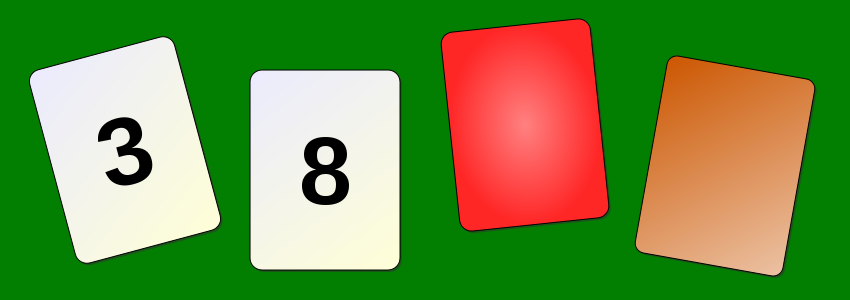
Wason Selection Task Cards

Original Question:
Each card has a number on one side, and a patch of color on the other. Which card(s) must be turned over to test the idea that if a card shows an even number on one face, then its opposite face is red?

Question in Bahasa Indonesia:
Gambar di atas adalah 4 kartu yang masing-masing memiliki sisi huruf dan sisi angka. Jadi, dibalik kartu “3” dan “8” tertulis suatu huruf dan dibalik kartu “Merah” dan “Coklat” tertulis suatu angka. Anda harus membuka 2 kartu untuk memeriksa kebenaran dari pernyataan, “Jika sebuah kartu menunjukkan nilai genap di satu sisi, maka sisi sebaliknya adalah warna merah.”. Kartu manakah yang harus Anda buka?

Note:
The Wason selection task (or four-card problem) is a logic puzzle devised by Peter Cathcart Wason in 1966. It is one of the most famous tasks in the study of deductive reasoning.

Petunjuk

Untuk menjawab pertanyaan diatas akan lebih mudah jika kita memberikan konteks. Coba jawab pertanyaan di bawah ini:

Di sebuah bar terdapat 4 orang yang sedang minum.

Orang 1: Minum alkohol.
Orang 2: Minum non-alkohol.
Orang 3: Berumur 30 tahun.
Orang 4: Berumur 19 tahun.

Di dalam bar tersebut terdapat peraturan, “Semua yang minum alkohol harus berumur di atas 21 tahun.”.

Untuk memerika apakah aturan di atas ditaati, orang nomor berapa saja yang harus diperiksa? (Untuk Orang 1 dan Orang 2, kita harus memeriksa KTP-nya. Untuk Orang 3 dan Orang 4 kita periksa minumannya.)

[collapse]
Solution

The correct response is to turn over the 8 and the brown cards.

The rule was “If the card shows an even number on one face, then its opposite face is red.” Only a card with both an even number on one face and something other than red on the other face can invalidate this rule:

1. If the 3 card is red (or brown), that doesn’t violate the rule.
2. If the 8 card is brown, that violates the rule.
3. If the red card is odd (or even), that doesn’t violate the rule. Because it doesn’t necessarily mean that red card should only be facing an even number. Its only that an even number should be facing red but vice versa is not mandatory. As nothing is mentioned about odd numbers, even the odd numbers might be facing red. But its only that even numbers must be facing red.
4. If the brown card is even, that violates the rule.

Use of logic

The interpretation of “if” here is that of the material conditional in classical logic, so this problem can be solved by choosing the cards using modus ponens (all even cards must be checked to ensure they are red) and modus tollens (all non-red cards must be checked to ensure they are non-even).

[collapse]

Macbeth

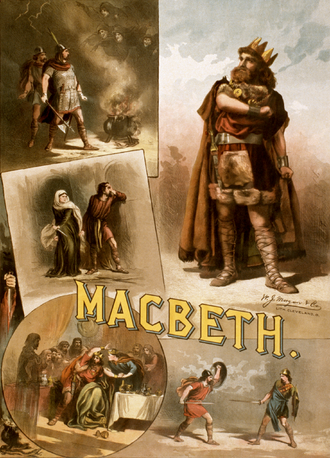
Macbeth

Macbeth adalah seorang jendral di bawah pemerintahan raja Skotlandia Duncan I. Pada suatu hari ia dan temannya Banquo bertemu dengan tiga tukang sihir yang meramalkan bahwa Macbeth bakal menjadi raja suatu hari, dan Banquo walaupun tidak akan menjadi raja tapi akan memperanakkan raja-raja.

Ketika Macbeth pulang dan memberitakan hal ini kepada istrinya Lady Macbeth, ia segera menyusun rencana untuk membunuh Duncan yang akan berkunjung dan menginap di rumah mereka. Setelah menjadi raja, Macbeth juga takut bahwa Banquo akan membocorkan rahasia tentang ketiga tukang sihir, dan memerintahkan ia dibunuh juga.

Sementara itu seorang jendral lain yang bernama Macduff menjadi curiga akan tingkah laku Macbeth yang menampakkan gejala-gejala ketakutan dan rasa bersalah. Ia kemudian bergabung dengan Malcolm dan Donalbain, kedua anak Duncan yang juga merasa curiga.

Perasaan takut Macbeth mendorongnya untuk mencari tukang-tukang sihir itu lagi, dan kali ini mereka meramalkan bahwa Macbeth akan tetap hidup “sampai hutan Great Birnam datang ke bukit Dunsinane”. Selain itu, juga bahwa Macbeth tidak akan dibunuh oleh seorang yang dilahirkan dari seorang wanita. Berpikir bahwa ini hal yang mustahil, Macbeth menjadi sombong dan puas akan jawaban ini. Tapi Lady Macbeth akhirnya tidak kuat lagi dan menjadi gila. Terutama ia merasa bahwa ada noda darah di tangannya yang tidak mau hilang walaupun dicuci berkali-kali.

Malcolm dan Macduff pergi ke Inggris dan merencanakan kudeta untuk membunuh Macbeth. Mereka akhirnya menyerang puri Macbeth dengan sekelompok prajurit, sambil membawa pucuk-pucuk pohon dari hutan Great Birnam sebagai samaran (hutan Birnam datang ke bukit Dunsinane). Macduff berhasil memaksa Macbeth untuk berduel dengannya. Macbeth masih merasa sombong karena berdasarkan ramalan tukang-tukang sihir, ia tidak akan pernah dibunuh oleh “seseorang yang dilahirkan dari seorang wanita”. Tetapi Macduff menjawab bahwa ia “diambil dari rahim ibunya” (dengan operasi caesar). Akhirnya Macduff berhasil memotong kepala Macbeth dan menyerahkan tahta kerajaan kepada Malcolm.

Catatan:

Macbeth adalah sandiwara tragedi karya William Shakespeare yang ditulis sekitar tahun 1606. Drama ini adalah salah satu tragedi Shakespeare yang terkenal dan juga yang paling pendek.

Tragedi ini menceritakan tentang ambisi yang berubah menjadi kejahatan, seorang jenderal yang mengkhianati rajanya, sahabatnya, bahkan jiwanya sendiri. “Fair is foul, and foul is fair” adalah inti dari Macbeth yang mengisahkan pahlawan-panglima Macbeth dan istrinya yang berambisi menjadi raja dan ratu Skotlandia. Mereka mengira bahwa satu-satunya jalan menuju tahta raja adalah melalui pedang. Tetapi niat jahat memiliki rencana sendiri untuk menampakkan jati dirinya.

Something

This is a follow-up to Was There Ever Nothing?

SomethingIf there ever was Absolutely Nothing, there would still be Absolutely Nothing today. Since there is something (you, for example), that means that Absolutely Nothing never existed. If it ever did, you wouldn’t be here reading this right now. Absolutely Nothing would still be here.

So there was never a time when Absolutely Nothing existed. Therefore, there has always been something. But what? If we go back to the very beginning, what was the Something that must have existed? Was it more than one Something, or just one? And what was it like, judging by what exists today?

Let’s explore the quantity issue first. Let’s call into mind again our large, pitch-black, sealed-off room. Imagine that there are ten tennis balls inside the room. As far back in time as we can go, there was only this: ten tennis balls.

What happens next? Let’s say we wait an entire year. What’s in the room? Still just ten tennis balls, right? Because there is no other force in existence. And we know that ten ordinary tennis balls — no matter how much time passes — cannot spawn new ones. Or anything else for that matter.

Okay, what if there were six tennis balls in the room to begin with? Would that change the situation? No, not really. Alright then, what if there were a million tennis balls? Still no change. All we’ve got in the room is tennis balls, no matter how many there are.

What we find out is that quantity is not an issue. If we go back to the very beginning of all things, the quantity of the Something that must have existed is not what’s important. Or is it?

Remove the tennis balls. Now inside the room is a chicken. Now we wait a year. What’s inside the room? Just one chicken, right? But what if we started out with one hen and one rooster in the room? Now we wait a year, what do we have? A bunch more chickens!

So quantity is important, IF inside the room are at least two things that can produce a third thing. Hen + rooster = baby chick. But quantity is not important if we’re talking about at least two things that cannot produce a third thing. Tennis ball + football = nothing.

So the issue isn’t quantity so much as quality. What qualities does the Something possess? Can it bring other things into existence?

Let’s go back to our chickens, but let’s get very exact, because such would be the case in the very, very beginning. We have a hen and a rooster in the room. They are in different parts of the room, suspended in nothingness. Will they produce other chickens?

No. Why? Because there’s no environment to work in. There’s nothing in the room except the hen and the rooster. No air to breathe or fly in, no ground to walk on, no sustenance for them to live on. They can’t eat, walk, fly or breathe. Their environment is complete nothingness.

So chickens are out. Chickens cannot exist or reproduce without some sort of environment. With an environment, they could spawn other chickens. And with an environment affecting them, maybe they could — though it seems absurd — change into a different kind of chicken over time. Something along the lines of an otter or a giraffe.

So we’ve got a room with no environment. Therefore, we need Something that can exist without an environment. Something that doesn’t need air, food or water to exist. That disqualifies every current living thing on this earth.

So, then, what about non-living things? They don’t need an environment, that’s true. But then we’re in the same predicament we were in with the tennis balls. Non-living matter doesn’t produce anything. Let’s say, instead of ten tennis balls, you had a trillion molecules of hydrogen. Then what happens? Over time, you still have a trillion molecules of hydrogen, nothing more.

While we’re talking about non-living matter, let’s also consider what it takes for that to exist. Ever heard of the Supercollider? Years ago the government embarked on an experiment to create matter. The Supercollider was miles and miles of underground tunnel through which atoms would travel at supersonic speeds and then smash into each other, in order to create a tiny particle. All that for the tiniest, most microscopic bit of matter.

What does that tell us? That our illustration of the ten tennis balls is not nearly as easy as it sounds. It would take an AMAZING amount of energy just to produce one tennis ball out of nothing. And nothing is all we have. The room has absolutely nothing in it.

So here’s where we are. The Something that existed at the beginning must be able to exist without depending on anything else. It must be totally and fully self-sufficient. For It was alone at the very beginning. And It needed no environment within which to exist.

Second, the Something that existed at the very beginning must have the ability to produce something other than Itself. For, if It could not, then that Something would be all that exists today. But Something Else exists today. You, for example.

Third, to produce Something Else — out of nothing — requires an incredible amount of power. So the Something must have great power at its disposal. If it takes us miles and miles of corridor and the most energy we can harness, just to produce the tiniest particle, how much power would it take to produce the matter in the universe?

Let’s go back to our room. Let’s say we have a very special tennis ball inside the room. It can produce other tennis balls. It has that much power and energy. And It is completely self-sufficient, needing nothing else to exist, for It is all there is. It, this one tennis ball, is the Eternal Something.

Let’s say the tennis ball produces another tennis ball. Which of the two will be greater, say, with respect to TIME? Ball #1. It is the Eternal Something. It has always existed. Ball #2, however, came into existence when produced by Ball #1. So one ball is finite with regard to time, the other infinite.

Which of the two will be greater with regard to POWER? Again, Ball #1. It has the ability to produce Ball #2 out of nothing — which also means it has the ability to unproduce (destroy) Ball #2. So Ball #1 has far more power than Ball #2. In fact, at all times, Ball #2 must depend on Ball #1 for its very existence.

But, you say, what if Ball #1 shared some of its power with Ball #2 — enough power to destroy Ball #1? Then Ball #2 would be greater, for Ball #1 would cease to be, right?

There’s a problem with this. If Ball #1 shared some of its power with Ball #2, it would still be Ball #1’s power. The question then becomes: could Ball #1 use its own power to destroy itself? No. First of all, to use its power, Ball #1 has to exist.

Second of all, Ball #1 is so powerful that anything that can possibly be done, can be done by Ball #1. But it is not possible for Ball #1 to cease to be, therefore it cannot accomplish this.

Ball #1 cannot be unproduced, for Ball #1 was never produced in the first place. Ball #1 has always existed. It is the Eternal Something. As such, it is existence. It is life, infinite life. For Ball #1 to be destroyed, there would need to be something greater. But nothing is greater than Ball #1, nor ever could be. It exists without need of anything else. It therefore cannot be changed by any external forces. It can have no end, for It has no beginning. It is the way it is and that cannot change. It cannot cease to be, for BEING is its very nature. In that sense, it is untouchable.

What we see is this: the Something at the very beginning will always be greater than the Something Else it produces. The Something exists on its own. Something Else, however, needs Something to exist. Therefore, Something Else has needs. It is therefore inferior to Something, and will always be so, for the Eternal Something has no need of another.

The Something might be able to produce Something Else that is like It in some ways, but — no matter what — Something Else will always be unlike It in other ways. The Eternal Something will always be greater with respect to time and power. Thus, the Eternal Something cannot produce an exact equal to Itself. It alone has always existed. It alone can exist independent of another.

Source: http://www.everystudent.com
Was There Ever Nothing?

“A thought journey on the beginning of time and the origin of the universe.”

NothingHave you ever thought about the beginning? What is that, you say? You know — whatever it was that showed up first. Or whatever it was that was here first, at the earliest moment in time. Have you ever strained your brain to think about that?

Wait a minute, you say, isn’t it possible that in the beginning there was nothing? Isn’t it possible that kazillions of years ago, there wasn’t anything at all? That’s certainly a theory to consider. So let’s consider it — but first by way of analogy.

Let’s say you have a large room. It’s fully enclosed and is about the size of a football field. The room is locked, permanently, and has no doors or windows, and no holes in its walls.

Inside the room there is … nothing. Absolutely nothing. Not a particle of anything. No air at all. No dust at all. No light at all. It’s a sealed room that’s pitch black inside. Then what happens?

Well, let’s say your goal is to get something — anything at all — into the room. But the rules are: you can’t use anything from outside the room to do that. So what do you do?

Well, you think, what if I try to create a spark inside the room? Then the room would have light in it, even for just a moment. That would qualify as something. Yes, but you are outside the room. So that’s not allowed.

But, you say, what if I could teleport something into the room, like in Star Trek? Again, that’s not allowable, because you’d be using things from outside the room.

Here again is the dilemma: you have to get something inside the room using only what’s in the room. And, in this case, what’s in the room is nothing.

Well, you say, maybe a tiny particle of something will just show up inside the room if given enough time.

There’s three problems with this theory. First, time by itself doesn’t do anything. Things happen over time, but it’s not time that makes them happen. For example, if you wait 15 minutes for cookies to bake, it’s not the 15 minutes that bakes them, it’s the heat in the oven. If you set them on the counter for 15 minutes, they’re not going to bake.

In our analogy, we’ve got a fully enclosed room with absolutely nothing in it. Waiting 15 minutes will not, in and of itself, change the situation. Well, you say, what if we wait eons? An eon is merely a bunch of 15-minute segments all pressed together. If you waited an eon with your cookies on the counter, would the eon bake them?

The second problem is this: why would anything just “show up” in the empty room? It would need a reason why it came to be. But there is nothing inside the room at all. So what’s to stop that from remaining the case? There would be nothing inside the room to cause something to show up (and yet the reason must come from inside the room).

Well, you say, what about a tiny particle of something? Wouldn’t that have a greater chance of materializing in the room than something larger like, for example, a football?

That brings up the third problem: size. Like time, size is an abstract. It’s relative. Let’s say you have three baseballs, all ranging in size. One is ten feet wide, one is five feet wide, one is normal size. Which one is more likely to materialize in the room?

The normal-size baseball? No! It would be the same likelihood for all three. The size wouldn’t matter. It’s not the issue. The issue is whether or not any baseball of any size could just “show up” in our sealed, empty room.

If you don’t think the smallest baseball could just show up in the room, no matter how much time passed, then you must conclude the same thing even for an atom. Size is not an issue. The likelihood of a small particle materializing without cause is no different than a refrigerator materializing without cause!

Now let’s stretch our analogy further, literally. Let’s take our large, pitch-black room and remove its walls. And let’s extend the room so that it goes on infinitely in all directions. Now there is nothing outside the room, because the room is all there is. Period.

This black infinite room has no light, no dust, no particles of any kind, no air, no elements, no molecules. It’s absolute nothingness. In fact, we can call it Absolutely Nothing.

So here’s the question: if originally — bazillions of years ago — there was Absolutely Nothing, wouldn’t there be Absolutely Nothing now?

Yes. For something — no matter how small — cannot come from Absolutely Nothing. We would still have Absolutely Nothing.

What does that tell us? That Absolutely Nothing never existed. Why? Because, if Absolutely Nothing ever existed, there would still be Absolutely Nothing!

If Absolutely Nothing ever existed, there would not be anything outside it to cause the existence of anything.

Again, if Absolutely Nothing ever existed, there would still be Absolutely Nothing.

However, something exists. Actually, many things exist. You, for example, are something that exists, a very important something. Therefore, you are proof that Absolutely Nothing never existed.

Now, if Absolutely Nothing never existed, that means there was always a time when there was at least Something in existence. What was it?

Was it one thing or many things? Was it an atom? A particle? A molecule? A football? A mutant baseball? A refrigerator? Some cookies?

To find out, go to Something.

Source: http://www.everystudent.com

Quote #13

Who what am I? My answer: I am the sum total of everything that went before me, of all I have been seen done, of everything done-to-me. I am everyone everything whose being-in-the-world affected was affected by mine. I am anything that happens after I’ve gone which would not have happened if I had not come. Nor am I particularly exceptional in this matter; each “I”, everyone of the now-six-hundred-million-plus of us, contains a similar multitude. I repeat for the last time: to understand me, you’ll have to swallow a world.

Salman Rushdie

Scientist Funeral Speech

“When does a man die? When he is hit by a bullet? No! When he suffers a disease? No! When he ate a soup made out of a poisonous mushroom? No! A man dies when he is forgotten!”
-Dr. Hiluluk-

It is funny when we thought that someone is dead and we are all wrong. If we make an inspection, we know that the person is dead when his heart stops beating. It is quite true if we call the person is dead. Somehow, there are things that make them is not dead at all.

Technically, we store every memories with the person we love. Nerves that we have can easily triggers the memories. Sight will bring back the love memories. Smell will bring back the sad and romantic memories. And if someone had blood bonds biologically is a half copy of the dead person. In some extreme ways, the bone cells can be used, though to make a DNA copy and recreate the dead person.

Technically, we are emanating energy to everything around us. Those energies are some stored in people around us, specially those who are close to us. Remember that energy cannot be destroyed, then it made us live in others immortally. Knows that we are bouncing every photons that ever touch our skin. Those photons have the exact copy of our appearance, and again, as long as we are not die around a dark matter, we can quite sure that the photon is not destroyed.

No one has ever really died. No one, based on the theory above. And somehow we all live forever.

Source: www.adityayedija.com

Seorang Kakek Kehilangan Kuda

“Adakalanya kerugian menjadi awal keberuntungan; sebaliknya, keberuntungan menjadi awal kerugian.”
-50 Chinese Wisdom-

Alkisah di daerah utara China yang berbatasan dengan suku penggembala, hiduplah seorang kakek dengan anaknya. Mereka tinggal di sebuah rumah dan memelihara seekor kuda.

Suatu hari kuda mereka hilang, lari jauh melewati daerah perbatasan. Mendengar kabar ini, para tetangga berdatangan menyatakan rasa simpati dan menghibur mereka. Kakek itu berkata, “Terima kasih, Saudara sekalian. Saya pribadi beranggapan bahwa hilangnya kuda ini bukan tak mungkin dapat membawa suatu berkah.”

Beberapa bulan kemudian kudanya kembali dengan membawa seekor kuda lagi. Para tetangganya pun berdatangan untuk memberi selamat. Kali ini si kakek berkata, “Walaupun mendapatkan seekor kuda, tidak berarti hal ini suatu keberuntungan. Bisa saja kuda ini membawa bencana.”

Suatu hari, anaknya mencoba menunggang kuda tersebut, namun jatuh dan kakinya patah. Para tetangga berdatangan lagi, kali ini untuk menyatakan rasa simpati. Namun kakek itu berkata, “Bagaimana kalian yakin kejadian ini sesuatu yang buruk?”

Tidak lama setelah peristiwa itu, suku pengembara menyerang China bagian utara. Setiap pemuda yang sehat wajib ikut berperang untuk membela negara. Karena kaki anak itu patah, ia terlepas dari wajib militer dan selamatlah nyawanya. Mereka yang ikut berperang, hampir semuanya gugur.

Penerapan:

Manakah yang untung dan manakah yang rugi? Semua hal ada untung-ruginya. Oleh sebab itu janganlah terlalu bersedih bila Anda mengalami hal-hal yang kurang menyenangkan, seperti kehilangan dan kegagalan. Siapa tahu hal itu merupakan awal dari suatu keberuntungan?

Kita sering mendengar istilah “untungnya Indonesia”. Istilah itu menyiratkan makna bahwa orang yang mengucapkannya melihat sisi positif peristiwa yang terjadi. Misalnya, orang yang tertabrak sepeda motor masih dibilang untung, “Untung kakinya tidak patah.” Kalau pun kakinya patah satu, masih juga dibilang untung, “Untung tidak patah dua-duanya.” Bahkan kalau kedua kakinya patah, masih juga dibilang untung, “Untung tidak mati.”

Jadi, dalam setiap ketidakmujuran masih mungkin terselip keberuntungan. Tergantung kita, apakah kita mampu melihat dan menemukan titik keberuntungan itu, atau tidak.

Kalau Anda ingin merasakan kebahagiaan, sekali-sekali Anda perlu melihat dan membandingkan keadaan diri Anda dengan keadaan mereka yang lebih menderita. Niscaya Anda akan merasa lebih beruntung, lebih berbahagia, dan lebih bersyukur.

Ketika kakek kehilangan kuda, siapa yang tahu hal itu adalah keberuntungan?

Hey Arnold! Theory

Hey Arnold! Theory, is it true?

About every ’90s kid knows the Nickelodeon series, “Hey Arnold!”. The show about a small boy with an odd shaped head. That’s about the first thing you notice, the oddly shaped heads the characters have. We’ll get back to that later on.

I want to tell you one thing first. The show isn’t fiction. It has all happened. That’s why there are a lot of life lessons in it.

Arnold is a boy who lives in a “fictional” city. The city actually is New York. The poor area of New York, it’s clearly visible that Arnold lives in a ghetto. He’s just a poor orphan living in with his grandparents Gertie and Phil. Well, he BELIEVES he’s an orphan. He actually is the child of the people he believes to be his grandparents. The grandparents are mentally unstable and told Arnold that his real parents, of normal age, died in a plane crash. That’s not true at all.

Because Gertie and Phil were old when they “made” Arnold, he was born with a few conditions. One of them is hydrocephalus. That the reason his head has such an odd shape. There’s one type of hydrocephalus, the one Arnold suffers from, that’s called the Arnold Chiari syndrome. That’s the reason why the creators decided to call the boy Arnold.

Gertie and Phil themselves are mentally unstable. This is because of their age. This is also the reason why Phil sexually abused Arnold. Phil says to Arnold that it’s totally normal that a “grandparent” does this kind of stuff to their grandchildren.

Arnold is being bullied for his oddly shaped head. This is where another condition Arnold has comes in. Because of Gertie’s and Phil’s old age, Arnold suffers from several psychological conditions. This makes him see things that aren’t there. Because he’s bullied a lot, he escapes to an imaginary world, with imaginary friends. That’s the reason the other characters have weird shaped heads too. It makes him feel like he’s normal, and no one can pick on him because of his head. This also is the reason why Arnold believes that his parents are his grandparents, and that his real parents died in a plane crash. His condition makes him believe that it is reality.

But the reality behind the series is way worse. It is reality. It tells the story about a poor boy living in New York. It’s all based on facts. When the creator got lost in New York he accidentally got in to the poor area. It was really late, so he decided to stay at a hotel. Then he came across a 9-year old boy, the child of two people who were clearly too old to have children. He saw that the boy was mentally unstable, and he believed in all the things he made up. The creator decided to talk to the boy. He felt really sorry for the boy when he discovered the boy only had imaginary friends and would die if he didn’t get medical care quickly. He felt like he needed to do something. So he asked the boy if he could tell his story, and then he’d make sure that the boy’s life would become better.

But he didn’t. He just used the sad story for a TV programme. He just took advantage of it. All the misery was so successful as a children’s’ programme. He became rich and didn’t care about the poor boy suffering.

He did not tell anyone about the way he came up with the idea for the series. He knew that if the truth would come out, it would all be done for him. No one would support a programme created by someone who became rich over the misery of someone else. The secret was well kept for so many years. But when it all came out to one of the important people from the Nickelodeon found out, the show immediately got canceled.

So, now you know it all. Where the idea came from, what it really is about and why it ended. The boy probably is dead by now, we can’t help him anymore. But please, make sure no one takes advantage of someone else’s misery ever again. We can help all those poor kids in ghettos, but not by making a programme about them.

Debunking Hey Arnold! Theory

That Theory is all wrong!

Craig Bartlett is the creator of Hey Arnold!, I’ve read and watched many interviews of him talking about Hey Arnold!, he said that his own personal life was an inspiration for the show.

A friend of mine told me that his wife (Lisa Greoning, Matt Groening’s Sister) Lisa Simpson was the one who suggested for Helga Pataki to be “secretly deeply in love with Arnold”.

Another thing the Theory lies about is why Hey Arnold! got cancelled, the show got cancelled because in the early 2000’s Nickelodeon was going Movie Making, Hey Arnold! sadly wasn’t as big of a hit that the Rugrats was so they decided to cancell it.

So to answer your question with good news: NO! That Theory is completely wrong and that is not the true story for Hey Arnold!.