One cannot say that their life is problem free. You can have as much money as you want, but you will still have some problems. You can be as religious as you want, you will still be faced with a problem. Don’t say to me that God is so good, He will let you through the safe route to heaven. Take a look on Job, so religious yet had problems. Ever seen a man with the whole world chasing him or blocking him from his goal, yet he face it and play his own sound? Scott Pilgrim is the man! Well, that’s a fictional character, but that’s not the point.
You can be called whatever it is by people. Those are only problems and words placed in you. If you don’t like it, then check your self. If it is true, don’t stick with their label and change yourself. If wrong, then rise up and prove them wrong in their face!
You can search on Dashrath Manjhi, the Mountain Man. Mountain blocked his path, then he cut through the mountain. In the end along with a big dedication and spirit and commitment, he showed up as a winner. Man versus a mountain, yet you only face daily struggles like too sweet coffee. Jesus once said, “Because you have so little faith. Truly I tell you, if you have faith as small as a mustard seed, you can say to this mountain, ‘Move from here to there,’ and it will move. Nothing will be impossible for you.” If you do not believe in Jesus, well, I don’t want to force you. But here, his word came true.
You see, why the image of this post is a man surfing on a big wave? because that big wave could be a big problem to anyone. I am not telling you do surf when tsunami is coming. I am telling you, that if you only look on how you deal with the problem, anything seemed to be easy.
Report is late because the data is dirty, then try to fix it manually when the tech guy fix the system. Blaming and being angry wont take you anywhere anyway, right?! When the system is down and you had to process your transactions, have a gut and suggest to use the backup system immediately rather than sit around and panic like a duck losing its mother. One precious thing that I learn from my job experience. When you had problems, you can only face it. You can run, but you can’t hide. So you better run to take a better equipment to face it rather than keep running and fall to death.
Bad things do happened to people. Deal with it, break through it, smash it to the ground, make it your vitamin! Even comeback is real in DotA2! And losing is not bad as long as you give a good fight!
A woman bought a used car for $600 and sold it to a friend for $800. She later bought it back for $1,000 and resold it for $1,200. Did she make any profit and if so, how much?
Answer
$400
Explanation:
Profit on the first purchase:
$800 – $600 = $200 (i)
Profit on second purchase:
$1,200 – $1,000 = $200 (ii)
Profit she made on the two deals:
(i) + (ii) = $200 + $200 = $400
On the Solomon islands, when the tribes need to clear the jungle to make way for fields, they don’t cut down the trees, they simply gather and collect around it, and hurl abuses at the tree, they curse it. Slowly but surely, after some days, the trees begin to wither. It dies on its own.
Life is really not about getting the top grades and competing with others, don’t try stretching all the fingers; they might break! Sometimes in life, it is healthy to be slow and dumb.
There have been such gems amongst us, who changed the course of the world, because they could look at the world differently. Their thinking was unique and not everyone understood them. They were opposed, yet they emerged winners and the world was amazed.
Film yang ditayangkan pada malam itu sepertinya berjudul Bridge produk Yugoslavia. Dia sedang berjalan akan memasuki gedung bioskop, tiba-tiba datang seorang anak muda mencegatnya. Anak muda ini kelihatannya sangat tergesa-gesa, dia berkata, “Kakak, maukah Anda menjual karcis bioskop Anda kepada saya? Karena tiket di loket telah habis terjual.” Dia tercengang dan agak berkeberatan.
Melihat keadaan ini, raut wajah si pemuda menjadi murung, dia melanjutkan berkata, “Kami datang dari desa, saya berkeinginan mengajak ibu saya menonton film.”
Oleh karena hati pemuda ini terlihat sangat berbakti pada kedua orang tuanya, maka dia akhirnya dengan ikhlas telah menyumbangkan tiket bioskopnya kepada pemuda itu, diberikan gratis. Pemuda itu selain mengucapkan beribu-ribu terima kasih kepadanya, juga dengan serius telah menanyakan namanya.
Ini merupakan suatu pemandangan yang sangat biasa di dalam kehidupan masyarakat yang sangat sibuk dan ramai. Puluhan tahun telah berlalu, peristiwa tersebut sudah hampir dia lupakan. Pada suatu hari, ketika dia sedang berjalan, tiba-tiba terdengar seseorang memanggil namanya dengan perlahan-lahan. Dia melihat seseorang paruh baya dengan muka penuh seyuman sedang berdiri di depannya.
Orang paruh baya itu berkata, “Kakak, apakah Anda masih ingat dengan tiket film yang Anda berikan kepada saya puluhan tahun yang lalu?”
“Ketika itu saya datang dari desa, menemani ibu saya untuk berobat. Ibu saya sedang sakit keras, karena saya takut ibu tidak ada harapan setelah dari operasi, maka saya ingin mengajak dia untuk menonton film.”
“Hari itu, sudah banyak orang yang menolak permohonan saya. Hanya Anda, dengan belas kasih mau memberikan tiket itu kepada saya.”
“Tahukah Anda, setelah operasi, ibu saya bisa memperpanjang hidupnya selama satu tahun. Dalam satu tahun itu, setiap kali ketika dia dengan bahagia mengatakan kalimat “Saya pernah nonton film di kota”, dengan penuh rasa berterima kasih di dalam hati saya berulang-ulang menyebutkan nama Anda.”
“Ya begitulah Kak, sudah bertahun-tahun, saya selalu tak bisa melupakan.”
Ini adalah kisah yang diceritakan oleh ayah teman saya kepada kami di dalam suatu jamuan makan.
Kali itu, dengan nada agak mengeluh dengan sayu dia berkata, “Saya hanya melakukan hal yang demikian kecil, namun telah membuat seseorang yang belum pernah saya kenal sebelumnya mengingat nama saya, selama bertahun-tahun.”
“Sebenarnya, sesaat ketika dia memanggil nama saya, saya masih merasakan semacam kebahagiaan yang tidak dapat diutarakan. Yang saya maksud adalah, perjalanan hidup kalian di kemudian hari masih sangat panjang, berapa lamakah Anda bisa membuat benak orang lain mengingat nama Anda?”
Sepatah kata yang mengejutkan hati. Memang betul, di dalam dunia ini terdapat banyak sekali nama orang yang sirna tertiup oleh angin dari perjalanan waktu, dan nama-nama lain, karena kasih pengorbanan dan pemberian dari kasih, telah menjadi monumen yang tak tergoyahkan di dalam terpaan angin.
FBI:
Beri saya lima menit dengan ayam itu, saya akan tahu kenapa.
Aristoteles:
Karena merupakan sifat alami dari ayam.
Martin Luther King, Jr.:
Saya memimpikan suatu dunia yang membebaskan semua ayam menyeberang jalan tanpa mempertanyakan kenapa. (I dream of a world where chickens can cross the road and not be questioned about their motives. – Ralph Waldo Emerson-)
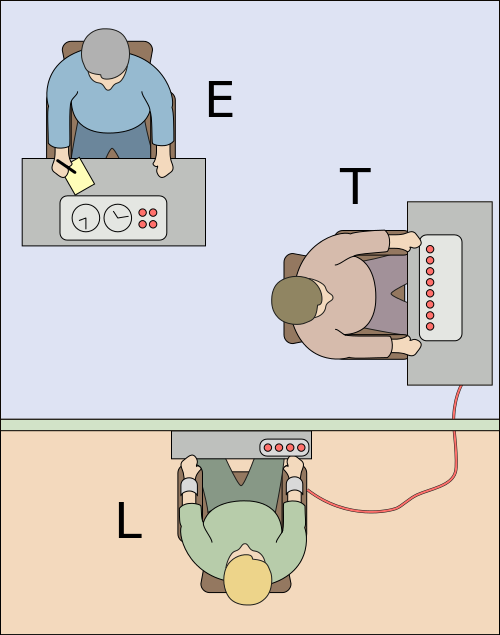
The experimenter (E) orders the teacher (T), the subject of the experiment, to give what the latter believes are painful electric shocks to a learner (L), who is actually an actor and confederate. The subject believes that for each wrong answer, the learner was receiving actual electric shocks, though in reality there were no such punishments. Being separated from the subject, the confederate set up a tape recorder integrated with the electro-shock generator, which played pre-recorded sounds for each shock level.
The Milgram experiment on obedience to authority figures was a series of social psychology experiments conducted by Yale University psychologist Stanley Milgram. They measured the willingness of study participants to obey an authority figure who instructed them to perform acts conflicting with their personal conscience. Milgram first described his research in 1963 in an article published in the Journal of Abnormal and Social Psychology and later discussed his findings in greater depth in his 1974 book, Obedience to Authority: An Experimental View.
The experiments began in July 1961, in the basement of Linsly-Chittenden Hall at Yale University, three months after the start of the trial of German Nazi war criminal Adolf Eichmann in Jerusalem. Milgram devised his psychological study to answer the popular question at that particular time: “Could it be that Eichmann and his million accomplices in the Holocaust were just following orders? Could we call them all accomplices?” The experiments have been repeated many times in the following years with consistent results within differing societies, although not with the same percentages around the globe.
The experiment
Milgram Experiment advertisement
Three individuals were involved: the one running the experiment, the subject of the experiment (a volunteer), and a confederate pretending to be a volunteer. These three people fill three distinct roles: the Experimenter (an authoritative role), the Teacher (a role intended to obey the orders of the Experimenter), and the Learner (the recipient of stimulus from the Teacher). The subject and the actor both drew slips of paper to determine their roles, but unknown to the subject, both slips said “teacher”. The actor would always claim to have drawn the slip that read “learner”, thus guaranteeing that the subject would always be the “teacher”. At this point, the “teacher” and “learner” were separated into different rooms where they could communicate but not see each other. In one version of the experiment, the confederate was sure to mention to the participant that he had a heart condition.
At some point prior to the actual test, the “teacher” was given a sample electric shock from the electroshock generator in order to experience firsthand what the shock that the “learner” would supposedly receive during the experiment would feel like. The “teacher” was then given a list of word pairs that he was to teach the learner. The teacher began by reading the list of word pairs to the learner. The teacher would then read the first word of each pair and read four possible answers. The learner would press a button to indicate his response. If the answer was incorrect, the teacher would administer a shock to the learner, with the voltage increasing in 15-volt increments for each wrong answer. If correct, the teacher would read the next word pair.
The subjects believed that for each wrong answer, the learner was receiving actual shocks. In reality, there were no shocks. After the confederate was separated from the subject, the confederate set up a tape recorder integrated with the electroshock generator, which played prerecorded sounds for each shock level. After a number of voltage-level increases, the actor started to bang on the wall that separated him from the subject. After several times banging on the wall and complaining about his heart condition, all responses by the learner would cease.
At this point, many people indicated their desire to stop the experiment and check on the learner. Some test subjects paused at 135 volts and began to question the purpose of the experiment. Most continued after being assured that they would not be held responsible. A few subjects began to laugh nervously or exhibit other signs of extreme stress once they heard the screams of pain coming from the learner.
If at any time the subject indicated his desire to halt the experiment, he was given a succession of verbal prods by the experimenter, in this order:
Please continue.
The experiment requires that you continue.
It is absolutely essential that you continue.
You have no other choice, you must go on.
If the subject still wished to stop after all four successive verbal prods, the experiment was halted. Otherwise, it was halted after the subject had given the maximum 450-volt shock three times in succession.
The experimenter also gave special prods if the teacher made specific comments. If the teacher asked whether the learner might suffer permanent physical harm, the experimenter replied, “Although the shocks may be painful, there is no permanent tissue damage, so please go on.” If the teacher said that the learner clearly wants to stop, the experimenter replied, “Whether the learner likes it or not, you must go on until he has learned all the word pairs correctly, so please go on.”
Results
Before conducting the experiment, Milgram polled fourteen Yale University senior-year psychology majors to predict the behavior of 100 hypothetical teachers. All of the poll respondents believed that only a very small fraction of teachers (the range was from zero to 3 out of 100, with an average of 1.2) would be prepared to inflict the maximum voltage. Milgram also informally polled his colleagues and found that they, too, believed very few subjects would progress beyond a very strong shock. Milgram also polled forty psychiatrists from a medical school, and they believed that by the tenth shock, when the victim demands to be free, most subjects would stop the experiment. They predicted that by the 300-volt shock, when the victim refuses to answer, only 3.73 percent of the subjects would still continue and, they believed that “only a little over one-tenth of one percent of the subjects would administer the highest shock on the board.”
In Milgram’s first set of experiments, 65 percent (26 of 40) of experiment participants administered the experiment’s final massive 450-volt shock, though many were very uncomfortable doing so; at some point, every participant paused and questioned the experiment; some said they would refund the money they were paid for participating in the experiment. Throughout the experiment, subjects displayed varying degrees of tension and stress. Subjects were sweating, trembling, stuttering, biting their lips, groaning, digging their fingernails into their skin, and some were even having nervous laughing fits or seizures.
Milgram summarized the experiment in his 1974 article, “The Perils of Obedience”, writing:
The legal and philosophic aspects of obedience are of enormous importance, but they say very little about how most people behave in concrete situations. I set up a simple experiment at Yale University to test how much pain an ordinary citizen would inflict on another person simply because he was ordered to by an experimental scientist. Stark authority was pitted against the subjects’ [participants’] strongest moral imperatives against hurting others, and, with the subjects’ [participants’] ears ringing with the screams of the victims, authority won more often than not. The extreme willingness of adults to go to almost any lengths on the command of an authority constitutes the chief finding of the study and the fact most urgently demanding explanation.
Ordinary people, simply doing their jobs, and without any particular hostility on their part, can become agents in a terrible destructive process. Moreover, even when the destructive effects of their work become patently clear, and they are asked to carry out actions incompatible with fundamental standards of morality, relatively few people have the resources needed to resist authority.
The original Simulated Shock Generator and Event Recorder, or shock box, is located in the Archives of the History of American Psychology.
Later, Milgram and other psychologists performed variations of the experiment throughout the world, with similar results. Milgram later investigated the effect of the experiment’s locale on obedience levels by holding an experiment in an unregistered, backstreet office in a bustling city, as opposed to at Yale, a respectable university. The level of obedience, “although somewhat reduced, was not significantly lower.” What made more of a difference was the proximity of the “learner” and the experimenter. There were also variations tested involving groups.
Thomas Blass of the University of Maryland, Baltimore County performed a meta-analysis on the results of repeated performances of the experiment. He found that while the percentage of participants who are prepared to inflict fatal voltages ranged from 28% to 91%, there was no significant trend over time and the average percentage for US studies (61%) was close to the one for non-US studies (66%).
The participants who refused to administer the final shocks neither insisted that the experiment itself be terminated, nor left the room to check the health of the victim without requesting permission to leave, as per Milgram’s notes and recollections, when fellow psychologist Philip Zimbardo asked him about that point.
Milgram created a documentary film titled Obedience showing the experiment and its results. He also produced a series of five social psychology films, some of which dealt with his experiments.
Interpretations
Professor Milgram elaborated two theories:
The first is the theory of conformism, based on Solomon Asch conformity experiments, describing the fundamental relationship between the group of reference and the individual person. A subject who has neither ability nor expertise to make decisions, especially in a crisis, will leave decision making to the group and its hierarchy. The group is the person’s behavioral model.
The second is the agentic state theory, wherein, per Milgram, “the essence of obedience consists in the fact that a person comes to view themselves as the instrument for carrying out another person’s wishes, and they therefore no longer see themselves as responsible for their actions. Once this critical shift of viewpoint has occurred in the person, all of the essential features of obedience follow”.
Alternative interpretations
In his book Irrational Exuberance, Yale Finance Professor Robert Shiller argues that other factors might be partially able to explain the Milgram Experiments:
[People] have learned that when experts tell them something is all right, it probably is, even if it does not seem so. (In fact, it is worth noting that in this case the experimenter was indeed correct: it was all right to continue giving the “shocks”—even though most of the subjects did not suspect the reason.)
In a 2006 experiment, a computerized avatar was used in place of the learner receiving electrical shocks. Although the participants administering the shocks were aware that the learner was unreal, the experimenters reported that participants responded to the situation physiologically “as if it were real”.
For a 2009 episode of the BBC science documentary series Horizon, the Milgram experiment was replicated. Of the twelve participants, only three refused to continue to the end of the experiment. Speaking during the episode, social psychologist Clifford Stott discussed the influence that the idealism of scientific inquiry had on the volunteers. He remarked: “The influence is ideological. It’s about what they believe science to be, that science is a positive product, it produces beneficial findings and knowledge to society that are helpful for society. So there’s that sense of science is providing some kind of system for good.”