Stop Saying “Sorry” And Say “Thank You” Instead

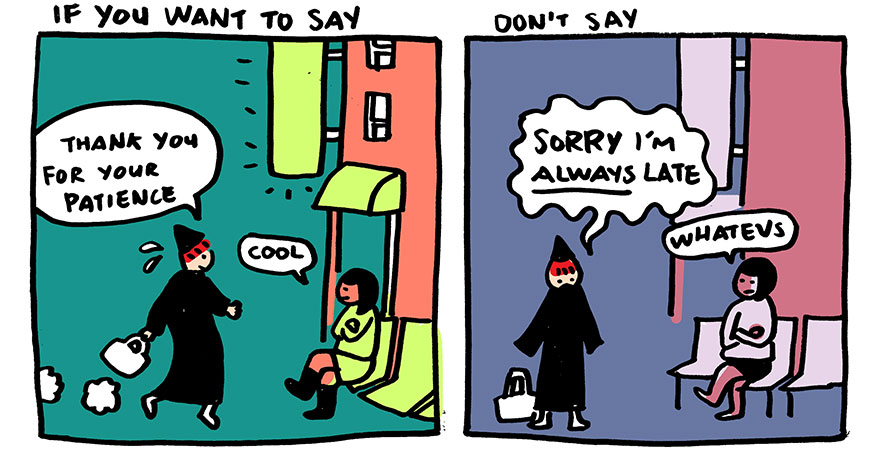
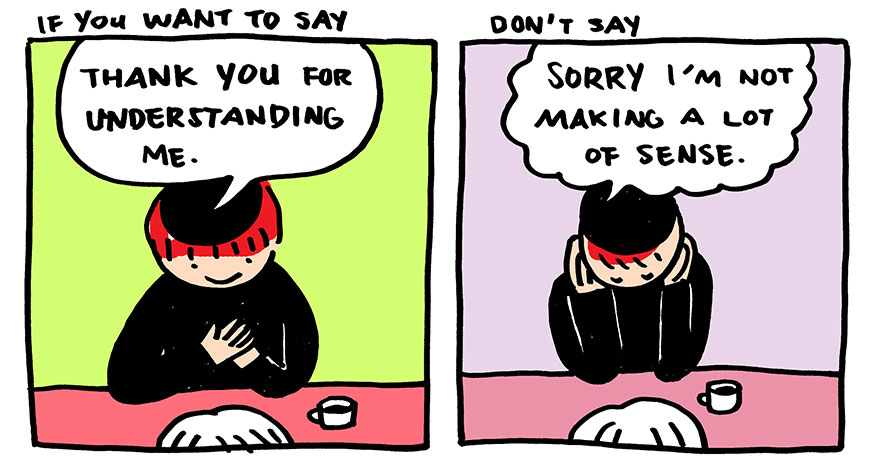
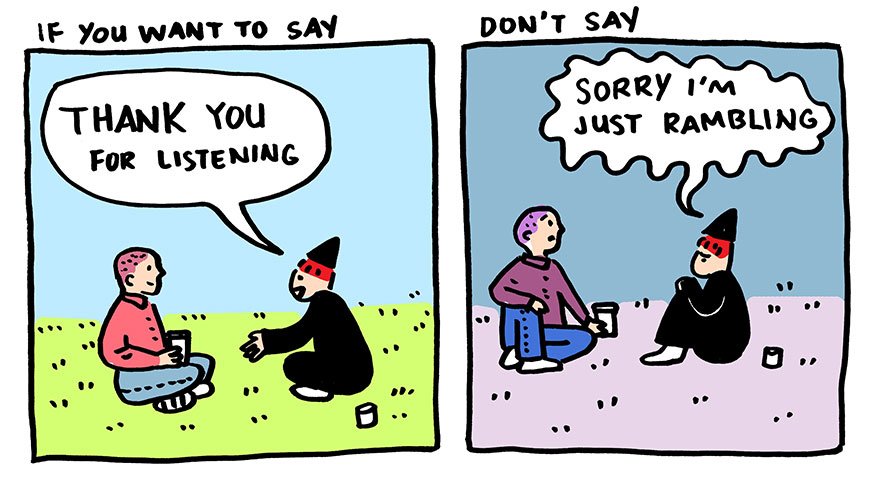
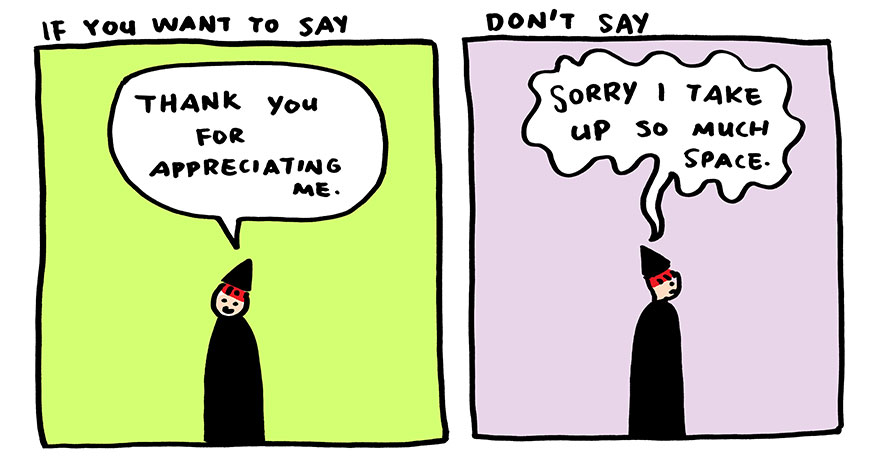
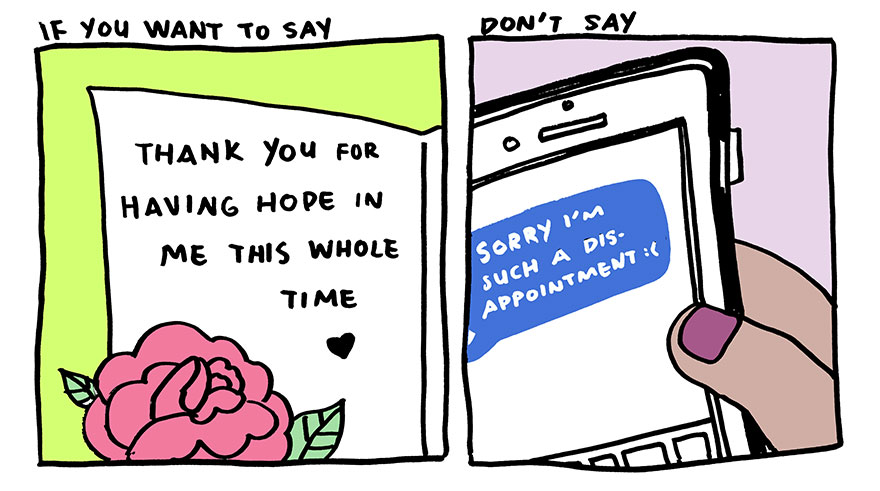
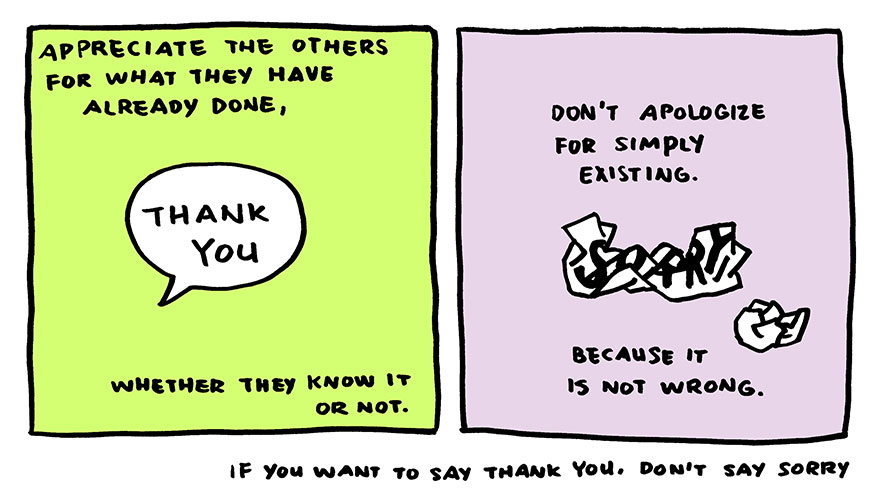
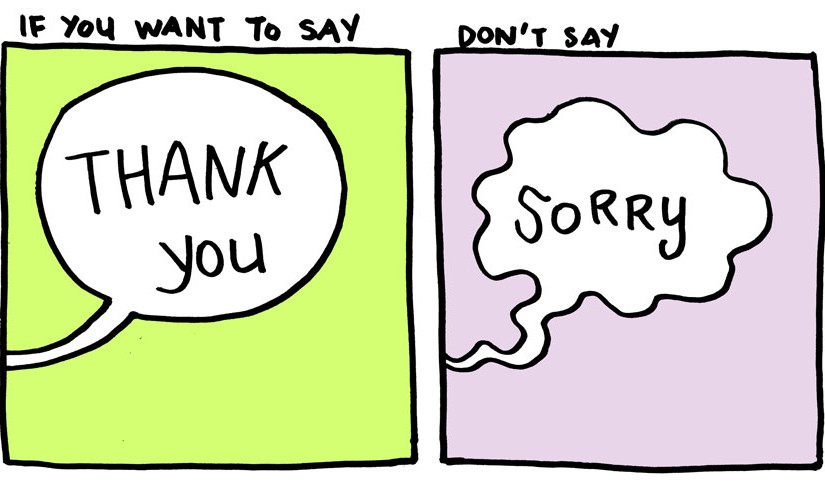
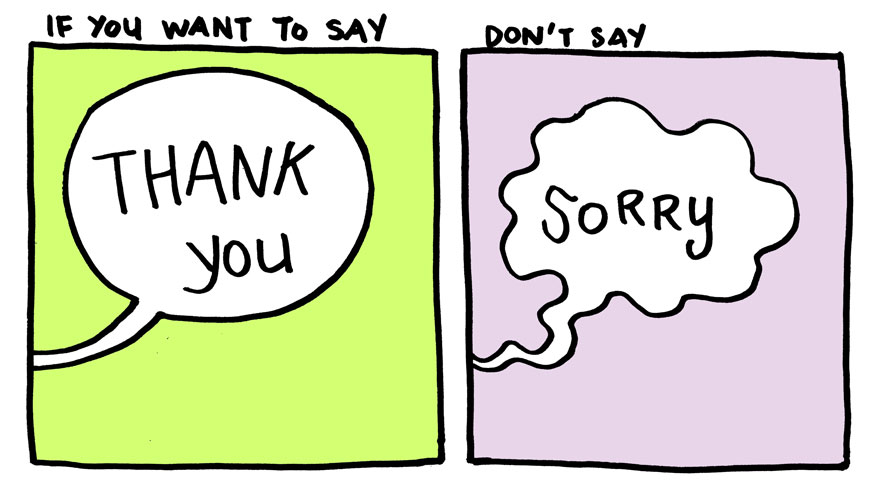
Unless you’re Canadian, you’re not doing anyone any favors by saying “sorry” all the time. New York based artist Yao Xiao takes this a step further in her comics, where she suggests that you say “thank you” instead. The Internet is full of empty promises and terrible art, but this idea is worth paying attention to; see how using “thank you” instead of “sorry” plays out below.

Yao Xiao was born in China but now lives in New York. Many of her comics are autobiographical, and she describes herself as an “enthusiast for queer fashion, vintage cabaret, collecting odd objects, and absurd science fiction with a flair of whimsy.” The rest of Xiao’s work is quite different from the comics below, so be sure to check out her website!

Stop Saying Sorry Say Thank You Instead- Comic Yao Xiao #8

Stop Saying Sorry Say Thank You Instead- Comic Yao Xiao #1

Stop Saying Sorry Say Thank You Instead- Comic Yao Xiao #2

Stop Saying Sorry Say Thank You Instead- Comic Yao Xiao #3

Stop Saying Sorry Say Thank You Instead- Comic Yao Xiao #4

Stop Saying Sorry Say Thank You Instead- Comic Yao Xiao #5

Stop Saying Sorry Say Thank You Instead- Comic Yao Xiao #6

Stop Saying Sorry Say Thank You Instead- Comic Yao Xiao #7

Quote #38

You think man can destroy the planet? What intoxicating vanity. Let me tell you about our planet. Earth is four-and-a-half-billion-years-old. There’s been life on it for nearly that long, 3.8 billion years. Bacteria first; later the first multicellular life, then the first complex creatures in the sea, on the land. Then finally the great sweeping ages of animals, the amphibians, the dinosaurs, at last the mammals, each one enduring millions on millions of years, great dynasties of creatures rising, flourishing, dying away — all this against a background of continuous and violent upheaval. Mountain ranges thrust up, eroded away, cometary impacts, volcano eruptions, oceans rising and falling, whole continents moving, an endless, constant, violent change, colliding, buckling to make mountains over millions of years. Earth has survived everything in its time. It will certainly survive us. If all the nuclear weapons in the world went off at once and all the plants, all the animals died and the earth was sizzling hot for a hundred thousand years, life would survive, somewhere: under the soil, frozen in Arctic ice. Sooner or later, when the planet was no longer inhospitable, life would spread again. The evolutionary process would begin again. It might take a few billion years for life to regain its present variety. Of course, it would be very different from what it is now, but the earth would survive our folly, only we would not. If the ozone layer gets thinner, ultraviolet radiation sears the earth, so what? Ultraviolet radiation is good for life. It’s powerful energy. It promotes mutation, change. Many forms of life will thrive with more UV radiation. Many others will die out. Do you think this is the first time that’s happened? Think about oxygen. Necessary for life now, but oxygen is actually a metabolic poison, a corrosive glass, like fluorine. When oxygen was first produced as a waste product by certain plant cells some three billion years ago, it created a crisis for all other life on earth. Those plants were polluting the environment, exhaling a lethal gas. Earth eventually had an atmosphere incompatible with life. Nevertheless, life on earth took care of itself. In the thinking of the human being a hundred years is a long time. A hundred years ago we didn’t have cars, airplanes, computers or vaccines. It was a whole different world, but to the earth, a hundred years is nothing. A million years is nothing. This planet lives and breathes on a much vaster scale. We can’t imagine its slow and powerful rhythms, and we haven’t got the humility to try. We’ve been residents here for the blink of an eye. If we’re gone tomorrow, the earth will not miss us.

Michael Crichton

Arthur Ashe – Mengapa Saya?

If I were to say, “God, why me?” about the bad things, then I should have said, “God, why me?” about the good things that happened in my life.
-Arthur Ashe-

Arthur Ashe adalah seorang petenis kulit hitam legendaris asal Amerika. Prestasinya sungguh luar biasa. Tiga gelar Grand Slam, turnamen paling bergengsi tersimpan di lemari kacanya. Gelar itu adalah US Open (1968), Australian Open (1970), dan Wimbledon (1975). Sebuah prestasi yang sulit diraih pada masa itu.

Selesai berkarir di lapangan, dia pun gantung raket. Namun dia bernasib kurang bagus. Pada 1979, ia terkena serangan jantung. Dokter memutuskan ia harus operasi Bypass jantung. Dua kali operasi dijalankan agar Ashe sembuh.

Tapi bukan sembuh yang didapat. Operasi ternyata membawa bencana lain. Dari transfusi darah, dia mendapat virus yang sekarang dikenal dengan nama HIV pada 1983. Pada masa itu, pengawasan terhadap berjangkitnya virus ini memang masih rendah.

Kenyataan pahit ini ia sembunyikan kepada publik. Sampai akhirnya, pada April 1992, koran terkemuka USA Today menurunkan laporannya mengenai kondisi kesehatannya. Sontak publik pun tercengang. Kebanyakan dari mereka menyayangkan tragedi yang menimpa petenis yang rendah hati itu.

Sepucuk surat dari seorang pengagumnya pun sampai ke tangannya. Penggemar itu menyatakan keprihatinannya. Dalam suratnya, sang penggemar bertanya, “Why did God have to select you for such a bad disease?” Pertanyaan yang biasa saja, tapi sungguh dalam, “Mengapa Tuhan memilihmu untuk menderita penyakit ini?”

Arthur menjawab, “Begini. Di dunia ini ada 50 juta anak yang ingin bermain tenis, diantaranya 5 juta orang yang bisa belajar bermain tenis, 500 ribu orang belajar menjadi pemain tenis profesional, 50 ribu orang datang ke arena untuk bertanding, 5000 orang mencapai turnamen Grand Slam, 50 orang berhasil sampai ke Wimbledon, 4 orang di semifinal, 2 orang di final. Dan ketika saya mengangkat trofi Wimbledon, saya tidak pernah bertanya kepada Tuhan, ‘Mengapa saya yang menjadi juara?’ Jadi ketika saya dalam kesakitan, tidak seharusnya juga saya bertanya kepada Tuhan, ‘Mengapa saya?'”

Pada 6 Februari 1993, Ashe mengembuskan napas terakhirnya. Dua bulan sebelum mengembuskan napas terakhirnya, Ashe mendirikan Arthur Ashe Institute for Urban Health. Dan beberapa minggu sebelum ia wafat, Ashe masih menyempatkan diri menulis memoarnya yang berjudul “Days of Grace“.
Kedamaian Yang Sejati

Seorang Raja mengadakan sayembara dan akan memberi hadiah berlimpah kepada siapa saja yang bisa melukis tentang kedamaian. Ada banyak seniman dan pelukis yang berusaha keras untuk memenangkan lomba tersebut.

Ketika sayembara telah usai, sang Raja berkeliling melihat-lihat hasil karya mereka. Hanya ada dua buah lukisan yang paling disukainya. Tapi, sang Raja harus memilih satu diantara keduanya.

Lukisan pertama menggambarkan sebuah telaga yang tenang. Permukaan telaganya bagaikan cermin sempurna yang mematulkan kedamaian gunung- gunung yang menjulang tenang disekitarnya. Di atasnya terpampang langit biru dengan awan putih berarak-arak. Semua yang memandang lukisan ini akan berpendapat, inilah lukisan terbaik mengenai kedamaian.

Lukisan kedua menggambarkan pegunungan juga. Namun tampak kasar dan gundul. Di atasnya terlukis langit yang gelap dan merah menandakan turunnya hujan badai, sedangkan tampak kilat menyambar-nyambar liar. Di sisi gunung ada air terjun deras yang berbuih-buih, sama sekali tidak menampakkan ketenangan dan kedamaian.

Tapi, sang Raja melihat sesuatu yang menarik, di balik air terjun itu tumbuh semak-semak kecil diatas sela-sela batu. Di dalam semak-semak itu seekor induk burung pipit meletakkan sarangnya. Jadi, ditengah-tengah riuh rendahnya air terjun, seekor induk pipit sedang mengerami telurnya dengan damai. Benar-benar damai.

Lukisan manakah yang memenangkan lomba?

Sang Raja memilih lukisan nomor dua.

“Wahai Raja, kenapa Raja memilih lukisan nomor dua?”

Sang Raja menjawab, “Kedamaian bukan berarti kau harus berada di tempat yang tanpa keributan, kesulitan atau pun pekerjaan yang keras dan sibuk. Kedamaian adalah hati yang tenang dan damai, meskipun kau berada di tengah-tengah keributan luar biasa.”

Quote #34 – Ego Traps

If you think it is more “spiritual” to ride a bike to work or use public transportation, but then find yourself judging anyone who drives a car, you’re in an ego trap.

If you think it is more “spiritual” to stop watching television because it rots your brain, but then find yourself judging those who still watch TV, you’re in an ego trap.

If you think it is more “spiritual” to avoid reading gossip, tabloid or news magazines, but then find yourself judging those who do read those things, you’re in an ego trap.

If you think it is more “spiritual” to listen to classical music or soothing nature sounds, but then find yourself judging those who listen to mainstream or pop music, you’re in an ego trap.

If you think it is more “spiritual” to do yoga, become a vegan, buy organic, buy healing crystals, practice Reiki, meditate, wear hippie/thrift shop clothing, visit ashrams and read enlightened spiritual books, but then you judge anyone Who doesn’t do those things, you’re in an ego trap.

Always be aware of the feeling of superiority. Self-righteous superiority is your biggest clue that you are in an ego trap. The ego loves to sneak in the back door. It will take a noble idea, like starting up yoga, and then twist it to serve its own ends by making you feel superior to others; you will start to look down on those who are not following your righteous “spiritual” path. Superiority, judgment and condemnation. That is the ego trap.

Anonymous